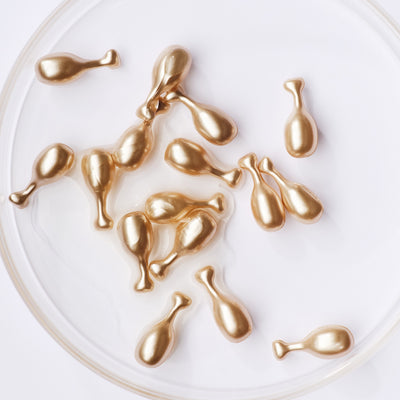
Retinol
INCI: Retinol
A form of vitamin A that can make fine lines less visible
Good evidence: randomised trials
At a glance
- Suits
- Normal, dry, combination and mature skin
- Helps with
- Fine lines, Pigmentation spots
- Pairs well with
- Hyaluronic acid, Niacinamide, Panthenol, Ceramide NP, Squalane
- Found in
- 1 ECOOKING product
What can retinol help with?
Fine lines
After 26 weeks, fine lines had improved in 27 of 54 women on the side of the face that received 0.075 % retinol, compared with 13 on the side that received the same cream without retinol.[1] In older people, 0.4 % retinol on the arms resulted in fewer fine lines after 24 weeks.[2]
Pigmentation spots
With 0.5 % retinol for 12 weeks, pigmentation spots became less visible. The study compared it with bakuchiol and had no group without an active ingredient.[3]
How it works
How to use it
- Start with 2–3 evenings a week, and gradually increase use once your skin has adjusted.
- Use retinol in the evening on clean, dry skin, and apply a moisturising cream on top.
- Use sunscreen during the day.
- Use one vitamin A product at a time.
- Avoid retinol if you are pregnant, trying to get pregnant or breastfeeding.
Products with retinol

Retinol Serum
Pure retinol in capsules that reduces fine lines, pigmentation spots, pores a...

Frequently asked questions
Retinol is one of the forms of vitamin A used in skincare. Vitamin A also exists as, for example, retinyl palmitate, retinal and HPR, and they all belong to the retinoid group.
The skin converts retinol to retinal and then to retinoic acid, the active form of vitamin A. Retinal is therefore one step closer to the active form than retinol.
Yes, in the same routine. You can use vitamin C in the morning and retinol in the evening, so the skin does not get too much at once.
In the EU, products for the face and hands may contain no more than 0,3 % retinol, and a body lotion no more than 0,05 %. The limit also applies to retinyl acetate and retinyl palmitate, calculated as retinol.
Retinol is found in our Retinol Serum in two strengths, 0,15 % and 0,25 %. Vitamin A Treatment contains another form of vitamin A, HPR.
Sources
- Improvement of photoaged facial skin in middle-aged Japanese females by topical retinol (vitamin A alcohol): a vehicle-controlled, double-blind study (Journal of dermatological treatment, 2009)
- Improvement of naturally aged skin with vitamin A (retinol) (Archives of dermatology, 2007)
- Prospective, randomized, double-blind assessment of topical bakuchiol and retinol for facial photoageing (British journal of dermatology, 2019)
- Evidence for the Efficacy of Over-the-counter Vitamin A Cosmetic Products in the Improvement of Facial Skin Aging: A Systematic Review (Journal of clinical and aesthetic dermatology, 2021)
- Tolerance profile of retinol, retinaldehyde and retinoic acid under maximized and long-term clinical conditions (Dermatology, 1999)
- Vitamin A (retinol, retinyl acetate, retinyl palmitate): opinion of the Scientific Committee on Consumer Safety (European Commission, 2016)